Turn Processes Into Scalable Execution Frameworks
We structure, replicate, and implement the operational systems that growing organizations need to operate at scale — without rebuilding from scratch every time.

Most processes never become systems
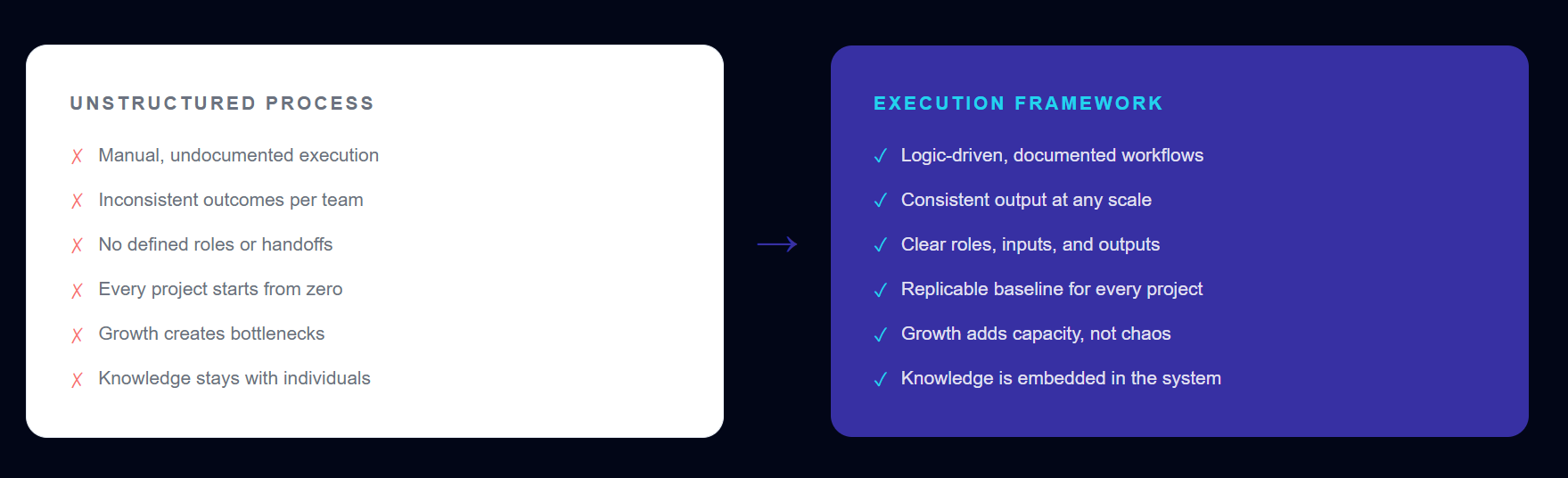
Organizations accumulate workflows, but without structure, they stay fragile. Each project starts over. Knowledge stays in individuals, not in systems. Growth stalls.The result: inconsistency at scale, dependency on key people, and an inability to replicate what works across teams, clients, or markets.
.png)
Repeated from scratch
Every new project reinvents the same process with no consistent baseline.
.png)
No replicable structure
What works once stays personal. It cannot be transferred, trained, or automated.
Scaling fails
Operations grow in volume but not in capacity. Teams slow down instead of accelerating.
.png)
People dependency
Critical knowledge lives in individuals, not in transferable, documented frameworks.
Three pillars of execution architecture
We turn operational reality into structured, repeatable, scalable systems through three coordinated disciplines.
.svg)
Process Analysis
We map what actually happens inside your operations — not what's in the manual. This gives us the raw material to design a framework that reflects real execution patterns.
.svg)
Framework Structuring
We convert analyzed processes into documented, logic-driven frameworks — modular systems that define inputs, outputs, roles, and decision points at every step.
.svg)
System Replication
We build the infrastructure to replicate the framework across projects, teams, or environments — so execution quality remains consistent regardless of volume or headcount.
From process to scalable system
What we deliver
.svg)
Process Structuring
Systematic analysis and documentation of your workflows, mapped to a logic-driven architecture ready for framework conversion.
.svg)
Framework Development
Custom execution frameworks built around your operational DNA — modular, transferable, and scalable by design.
.svg)
System Replication
Deployment of framework-based systems across multiple teams, projects, or markets with consistent quality control.

Implementation Support
Hands-on coordination during rollout — integrating the framework into active operations, training teams, and validating execution.
Built to run, not just to document
Our frameworks are designed for active execution — not static documentation. Each system is modular, testable, and deployable across operational contexts.
Execution Frameworks
Process Models
Scalable Systems
Repeatable Workflows
Operational from day one
We don't hand over documentation and leave. We coordinate the full rollout — from framework integration into active workflows to resource alignment and team coordination.
Our implementation model is designed for complex environments where change requires structured management. We assign dedicated coordination, define milestones, and validate execution at each stage before moving forward.

Structure
We define the framework architecture and align it with your existing operational environment.

Adapt
We customize the framework to fit your team structure, tools, and execution conditions.

Deploy
We integrate the framework into active operations and coordinate resource alignment.

Maintain
We provide ongoing support to validate execution quality and iterate on the system over time.
What our clients say
"Structovicora turned three years of tribal knowledge into a deployable system in six weeks. Our onboarding time dropped by 60% — and new hires execute at the same level as veterans."
What impressed us most is how intelligent and easy to customize the system is. From onboarding automation to handling complex FAQs, the chatbot delivers consistent and professional support at scale. It feels like adding a full
"The process audit alone was worth the engagement. They found gaps we hadn't seen in five years. The resulting execution model is now the backbone of everything we deliver to clients."
From integration to deployment, the entire experience was smooth and professional. The AI adapts quickly, learns from interactions, and continuously improves performance. It’s not just a chatbot—it’s a scalable.
"We used their Pre-Built Execution Framework package to deploy a baseline across four new markets simultaneously. The speed-to-operational was unlike anything we'd managed internally."

.avif)
.avif)

.avif)

Select a plan that suits your business.
Select from pricing plans that grow with your business.
Enterprise Execution Framework
A comprehensive execution framework covering full project lifecycle operations — from intake and scoping to delivery and closeout. Includes role matrices, decision logic, escalation paths, and 47 structured workflow components. Designed for project-based organizations with 5–50 operational staff. Fully documented, version-controlled, and adaptable to most business contexts without custom development.
$800
Execution Model Package — Professional Services
A purpose-built execution model for professional services firms — consultancies, agencies, and advisory businesses. Covers client engagement workflows, delivery management, quality control, and team coordination. Includes pre-configured logic for both project-based and retainer service models with built-in adaptation guidance for different practice areas.
$650
Process Template Library
A modular collection of 30+ documented process templates covering the most common operational workflows in service-based and project-based organizations. Each template includes step-by-step logic, role assignments, input/output definitions, and integration notes. Templates are designed to be combined into custom workflow systems without requiring full framework development.
$350
Workflow Structuring Kit
A structured toolkit for teams conducting their own workflow analysis and framework design. Includes analysis templates, process mapping guides, decision logic builders, and role mapping worksheets. Supported by a written methodology guide that walks teams through the structuring process step by step. Suitable for internal operations managers and process improvement leads.
$200
Implementation Readiness Package
A structured preparation package for organizations about to deploy a new framework or operational system. Includes a pre-implementation assessment tool, deployment planning templates, team readiness checklists, and a milestone tracking system. Reduces implementation risk by ensuring organizational readiness is assessed and addressed before rollout begins. Compatible with custom frameworks or pre-built framework products.
$280
Scalable Operations Blueprint
A system architecture document designed for organizations planning a scaling phase. Covers operational capacity planning, framework governance design, resource allocation logic, and quality control infrastructure. Includes a set of 12 pre-built monitoring templates and a governance model that can be adapted to organizations of 10–200 operational staff. Delivers a structured foundation for scale without the cost of full custom development.
